
THE BOOK OF 1 MACCABEES
Lesson 5: Chapter 4
The Battle of Emmaus and the Purification of the Temple
The rules for war according to the Law of Moses:
Yahweh your God is marching with you, to fight your enemies for you and make you victorious.
The scribes will then address the people, as follows:
"Has anyone built a new house and not yet enjoyed its fruit? Let him go home, in case he dies in battle, and someone else performs the dedication.
Has anyone planted a vineyard and not yet enjoyed its fruit? Let him go home, in case he dies in battle, and someone else enjoys its fruit.
Has anyone contracted to marry a girl and not yet married her? Let him go home, in case he dies in battle, and someone else marries her."
Finally, the scribes will say to the people: "Is anyone frightened or faint-hearted? Let him go home, in case he makes his brothers faint-hearted too!"
Then, when the scribes have finished speaking to the people, commanders will be appointed to lead them.
Deuteronomy 20:4-9
+ + +
Judas Maccabeus is described as a giant and a lion, winning victories for God's faithful warriors (1 Mac 3:1-9), and carrying out God's plan against the Hellenizing Jews and their Seleucid supporters as God's trustworthy instrument. With Judas's army facing a much larger enemy force, and unable to go to the Temple to worship because the Seleucids controlled Jerusalem, Judas assembled his army at Mizpah, a traditional place of prayer, and enacted the rules for war according to the Law of Moses, beginning with offering repentance for sins and pleading for God's guidance (1 Mac 3:45-60):
1 Maccabees 4:1-27 ~ The Battle of Emmaus
1 Gorgias took with him five thousand foot, and a thousand picked cavalry, and the force
moved off by night 2 with the object of attacking the Jewish position and
dealing them an unexpected blow; the men from the Citadel were there to guide
him. 3 Judas got wind of it, and himself moved off with his fighters to strike
at the royal army at Emmaus, 4 while its fighting troops were still dispersed
outside the camp. 5 Hence, when Gorgias reached Judas' camp, he found no one
and began looking for the Jews in the mountains. "For," he said, "we have got
them on the run." 6 First light found Judas in the plain with three thousand
men, although these lacked the armor and swords they would have wished. 7 They
could now see the gentile encampment with its strong fortifications and cavalry
surrounding it, clearly people who understood warfare. 8 Judas said to his men,
"Do not be afraid of their numbers, and do not flinch at their attack. 9
Remember how our ancestors were delivered at the Red Sea when Pharaoh was
pursuing them in force. 10 And now let us call on Heaven: if he cares for us,
he will remember his covenant with our ancestors and will destroy this army
confronting us today; 11 then all the nations will know for certain that there
is One who ransoms and saves Israel." 12 The foreigners looked up and, seeing
the Jews advancing against them, 13 came out of the camp to join battle. Judas'
men sounded the trumpet 14 and engaged them. The Gentiles were defeated and
fled towards the plain, 15 and all the stragglers fell by the sword. The
pursuit continued as far as Gezer and the plains of Idumaea, Azotus and Jamnia,
and the enemy lost about three thousand men. 16 Breaking off the pursuit, Judas
returned with his men 17 and said to the people, "Never mind the booty, for we
have another battle ahead of us. 18 Gorgias and his troops are still near us in
the mountains. First stand up to our enemies and fight them, and then you can
safely collect the booty." 19 The words were hardly out of Judas' mouth, when a
detachment came into view, peering down from the mountain. 20 Observing that
their own troops had been routed and that the camp had been fired "since the
smoke, which they could see, attested the fact " 21 they were panic-stricken at
the sight; and when, furthermore, they saw Judas' troops drawn up for battle on
the plain, 22 they all fled into Philistine territory. 23 Judas then turned
back to plunder the camp, and a large sum in gold and silver, with violet and
sea-purple stuffs, and many other valuables were carried off. 24 On their
return, the Jews chanted praises to Heaven, singing, "He is kind, and his love
is everlasting!" 25 That day had seen a remarkable deliverance in Israel. 26
Those of the foreigners who had escaped came and gave Lysias an account of all
that had happened. 27 The news shocked and dismayed him, for affairs in Israel
had not gone as he intended, and the result was quite the opposite to what the
king had ordered.
Gorgias, the director general of the King's army, whose mission was to destroy Judas's army, set out to catch the Jews in a surprise attack, using Hellenized apostate Jews from the citadel in Jerusalem. However, Judas was warned and moved out to attack the enemy at Emmaus while they were absent from their camp.
4:6 First light found Judas in the plain with three thousand men, although these
lacked the armor and swords they would have wished.
Typical weapons of this period for a professional army included wooden shields, helmets,
protective armor, two-handed pikes, axe blades, swords, and spears/javelins. Skilled
blacksmiths made hand weapons. However, the Israelite soldiers had none of
these metal weapons, but Judas had the sword he took from Apollonius (3:12).
Judas's men probably used slings they made as their primary weapon. Battlefields
throughout the ancient Levant are littered with small projectiles made of
stone, clay, or lead, launched from slingshots. For at least 1,000 years,
beginning as early as the fifth century BC, soldiers used stone or lead sling bullets
to maim or kill their enemies. You may recall David's encounter with Goliath,
in which David, armed only with a sling and five stones, killed Goliath with a
single shot (1 Sam 17:40-51). Scholars estimate that sling bullets could travel
up to 1,000 feet.1
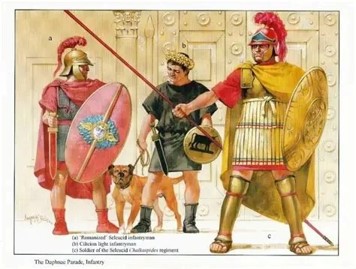
Typical Greek infantry soldiers
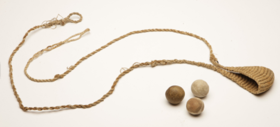
Typical ancient sling
A typical slingshot weapon made of cords. The cords for ancient weapons were usually very long, with the doubled cord reaching from the man's extended arm down against his thigh to just above the ground.
When they were ready to go against the enemy, Judas reminded his troops of the Israelites' victory over the Egyptians in the Exodus generation, to give them courage and to have faith that God would save them just as He had saved them from the Egyptians (verses 10-11, 24-25).
The first stage of the battle demonstrates Judas's superior strategy and tactical skills. Apostate Jews served as guides for Gorgias, but Judas eluded his adversaries. Later, when Judas's forces encountered the enemy, He reassured his men by recalling the Exodus from Egypt, when the Israelites were trapped by their enemy and in danger of becoming enslaved again (Ex 14). He also recalled passages from 2 Kings 19:19 and others that described how God rescued His covenant people.
15b The pursuit continued as far as Gezer and the plains of Idumaea, Azotus and Jamnia, and the
enemy lost about three thousand men.
Although Judas attacked Gezer, 2 Maccabees records that Simon captured it first
(2 Mac 10:32).
Gezer is in the foothills of the Judean Mountains at the border of the
Shephelah (lowlands), in central Israel. The site rises to 751 feet (229
meters) above sea level and offers a commanding view of the plains to the west,
north, and east. The plains of Idumaea were south of Judea. 2 Maccabees relates
that the Seleucid general Gorgias was the governor of Idumaea (2 Mac 12:32).
According to Josephus (Antiquities 14.4.4), Judas first defeated the
Idumaeans in the border towns of Hebron and Marisa c. 163 BC. Azotus is the
Greek name for the Philistine city of Ashdod, and Jamnia, also known as Yavne
or Jabneh, is an ancient city in Israel's coastal plain, about 20 miles south
of Joppa (modern-day Jaffa) and near the Mediterranean Sea.
In the battle, the Seleucids are defeated and lose half their troops. Judas does not let his men waste too much time plundering the enemy's camp because he does not want them weighed down with booty. Gorgias' contingents flee to Philistine lands.
23 Judas then turned back to plunder the camp, and a large sum in gold and silver,
with violet and sea-purple stuffs, and many other valuables were carried off.
After the Israelite troops plundered the enemy's camp (verse 23), they left it
singing hymns of praise, similar to those in Psalm 118 and 136.
Sea-purple, or Tyrian purple, is a deep reddish-purple dye made by crushing as many as 10,000 murex snails to produce a single gram. Textiles stained with this dye were extremely expensive and were therefore usually worn by kings. For thousands of years, from the Bronze Age through the end of the Roman Empire, purple dye was one of the world's rarest commodities.
24 On their return, the Jews chanted praises to Heaven, singing, "He is kind, and
his love is everlasting!"
Psalm 118 is the professional hymn traditionally sung for the Feast of Shelters (see 2 Chron 20:21 and the chart on
The Seven Sacred Feasts, and Their Fulfillment in Jesus Christ.
Judas used an intelligent strategy against the enemy, but the inspired writer stresses that God saved His people (verses 10-11 and 24-25). God used Judas and his small, poorly equipped army (verse 6) to give Israel victory.
26 Those of the foreigners who had escaped came and gave Lysias an account of all
that had happened. 27 The news shocked and dismayed him, for affairs in Israel
had not gone as he intended, and the result was quite the opposite to what the
king had ordered.
Lysias was greatly dismayed by the battle's outcome and realized he needed to raise a
much larger army, which he planned to lead himself.
1 Maccabees 4:28-35 ~ Lysias's Campaign
28 The next year he mobilized sixty thousand picked troops and five thousand
cavalry with the intention of finishing off the Jews. 29 They advanced into
Idumaea and made their base at Beth-Zur, where Judas met them with ten thousand
men. 30 When he saw their military strength, he offered this prayer, "Blessed
are you, Savior of Israel, who shattered the mighty warrior's attack at the
hand of your servant David, and delivered the Philistine camp into the hands of
Jonathan son of Saul, and his armor-bearer. 31 Crush this expedition in the
same way at the hands of your people Israel; let their troops and cavalry bring
them nothing but shame. 32 Sow panic in their ranks, confound the confidence
they put in their numbers and send them reeling in defeat. 33 Overthrow them by
the sword of those who love you, and all who acknowledge your name will sing
your praises." 34 The two forces engaged, and five thousand men of Lysias'
troops fell in hand-to-hand fighting. 35 Seeing the rout of his army and the
courage of Judas' troops and their readiness to live or die nobly, Lysias
withdrew to Antioch, where he recruited mercenaries for a further invasion of
Judaea in even greater strength.
The narrative now begins in the year 165/4 BC. The year after Judas's victory at Emmaus, Lysias, who governed the Seleucid empire while the king was away in Antioch (3:32), launched another attack on Judas and Jerusalem. This time, he attacked from the southeast, from Idumaea. Judas went to meet the enemy at Beth-Zur, a Syrian stronghold 19 miles (30 km) from Jerusalem on the border with Idumaea. Judas and his army achieved a great victory (verses 34-35). Lysias sought reinforcements, but the Syrians reached Jerusalem and laid siege to the city (cf. 2 Mac 11:13-15).
Judas also raised a much larger army, but he was still outnumbered about seven to one. Facing such discouraging odds, he again prepares for battle with prayer (verses 30-33), recalling Israel's historical successes against enemies. Judas prayed for God's protection and intervention, recalling the exploits of David and his friend Jonathan, the son of Saul (verses 30-33; cf. 1 Sam 14:1-23 and 17):
Judas asks God to destroy the Jews' enemies, who are also God's enemies.
Despite his superior forces, the battle once again goes against Lysias (verse 34). God answered his prayer, and Lysias's army withdrew to Antioch to recruit mercenaries for another invasion. 2 Maccabees includes that Lysias believed Judas's support would dwindle once the pressure of persecution was removed. The Seleucid army's withdrawal to Antioch allowed Judas to take control of Jerusalem and the Temple of Yahweh.
1 Maccabees 4:36-61 ~ Purification and Re-dedication of the Temple
36 Judas and his brothers then said, "Now that our enemies have been defeated, let
us go up to purify the sanctuary and dedicate it." 37 So they marshaled the
whole army, and went up to Mount Zion. 38 There they found the sanctuary
deserted, the altar desecrated, the gates burnt down, and vegetation growing in
the courts as it might in a wood or on some mountain, while the storerooms were
in ruins. 39 They tore their garments and mourned bitterly, putting dust on
their heads. 40 They prostrated themselves on the ground, and when the trumpets
gave the signal they cried aloud to Heaven. 41 Judas then ordered his men to
keep the Citadel garrison engaged until he had purified the sanctuary. 42 Next,
he selected priests who were blameless and zealous for the Law 43 to purify the
sanctuary and remove the stones of the Pollution' to some unclean place. 44
They discussed what should be done about the altar of burnt offering which had
been profaned, 45 and very properly decided to pull it down, rather than later
be embarrassed about it since it had been defiled by the Gentiles. They
therefore demolished it 46 and deposited the stones in a suitable place on the
hill of the Dwelling to await the appearance of a prophet who should give a
ruling about them. 47 They took unhewn stones, as the Law prescribed, and built
a new altar on the lines of the old one. 48 They restored the Holy Place and
the interior of the Dwelling and purified the courts. 49 They made new sacred
vessels, and brought the lamp-stand, the altar of incense, and the table into
the Temple. 50 They burned incense on the altar and lit the lamps on the
lamp-stand, and these shone inside the Temple. 51 They placed the loaves on the
table and hung the curtains and completed all the tasks they had undertaken. 52
On the twenty-fifth of the ninth month, Chislev, in the year 148, rose at dawn
53 and offered a lawful sacrifice on the new altar of burnt offering which they
had made. 54 The altar was dedicated, to the sound of hymns, zithers, lyres and
cymbals, at the same time of year and on the same day on which the Gentiles had
originally profaned it. 55 The whole people fell prostrate in adoration and
then praised Heaven, who had granted them success. 56 For eight days they
celebrated the dedication of the altar, joyfully offering burnt offerings,
communion and thanksgiving sacrifices. 57 They ornamented the front of the
Temple with crowns and bosses of gold, renovated the gates and storerooms,
providing the latter with doors. 58 There was no end to the rejoicing among the
people, since the disgrace inflicted by the Gentiles had been effaced. 59
Judas, with his brothers and the whole assembly of Israel, made it a law that
the days of the dedication of the altar should be celebrated yearly at the
proper season, for eight days beginning on the twenty-fifth of the month of Chislev,
with rejoicing and gladness. 60 They then proceeded to build high walls with
strong towers round Mount Zion, to prevent the Gentiles from coming and riding
roughshod over it as in the past. 61 Judas stationed a garrison there to guard
it; he also fortified Beth-Zur, so that the people would have a fortress
confronting Idumaea.
Not until a year later, in 164/63 BC, could Judas begin purifying and rededicating the Temple. When Judas and his men arrived at the Temple, they found it had been converted into a typical pagan sanctuary condemned in Jewish law (see Dt 12:2-3). Verse 38 describes the state of the deserted Temple. In horror, the first response of the faithful Jews was to mourn the desecration of their holy Temple in symbolic acts by tearing their garments, putting ashes or dust on their heads, and prostrating on the ground. When the trumpets sounded, they cried out to God in Heaven (verse 40). But before they could begin the purification and restoration, they had to attack the citadel manned by pagan sympathizers to neutralize it. Then they set about restoring the Temple according to Mosaic Law.
Judas and his men made cleansing the Temple of impurities and restoring religious worship their next priority. Judas entrusted the cleansing of the Temple to blameless priests (verse 42) according to the Law (cf. Lev 22:3-9):
2 Maccabees 10:1-8 mentions these events and includes instructions for how the fire for the sacrifices was made.
In verse 42, Judas chose blameless priests to begin the purification work. Unfortunately, many of the Jerusalem priesthood had apostatized from the covenant to become supporters of the Hellenizers. When the carefully chosen priests began the purification, a problem arose concerning the altar. Because it had been used for sacrifices to false gods, Mosaic Law commanded its destruction (verse 44, Dt 12:2-3), but the same law forbade destroying God's holy altar (Dt 11:4). They decided to demolish it but to save the stones until a holy prophet appeared to advise them (verse 45-46) and built a new altar out of unworked stone on the plan of the old one. In addition:
See the document on the plan of the Temple and the chart on the seven classes of furniture in the Temple.
The rededication probably took place in December 164 BC, three years to the day after the first pagan sacrifice (2 Macc 10:5). Their celebration is the origin of the annual national feast of Hanukkah, a feast of joy, prayer, and praise to God for allowing them to remove the disgrace from among the people, which has been celebrated every year since.2
In verses 60-61, Judas fortified the Temple Mount (the Temple's location at the high point of Mount Moriah) and stationed a garrison to protect the Temple from future attacks by the Greeks and Jewish Hellenists, and fortified Beth-Zur to repel any Idumaean attacks.
The Jerusalem Temple had three sacred spaces. The court with the Altar of Sacrifice was available to priests and covenant members bringing sacrifices. 2. The Holy Place was located within the Sanctuary and was attended by priests. It held the golden Menorah (lampstand, the table with the twelve loaves, and the Altar of Incense in front of the entrance to the Holy of Holies. 3. The Holy of Holies was where the Ark of the Covenant once stood in Solomon's Temple and was entered only by the High Priest once a year on the Feast of Yom Kippur, the Feast of Atonement.3
Endnotes:
1. Benjamin
Leonard, in his article "Slinging Insults" (Archaeology Magazine, July/August
2026, pages 38-39), reports that archaeologists have found sling bullets at
sites throughout the Mediterranean, the Levant, and Anatolia. Archaeologists
found lead sling bullets cast in molds, enabling artillery units to
mass-produce them while on campaign. Many were inscribed with city names,
military units, and commanders. Some included the names of gods to seek divine
aid. Others, fired throughout the ancient Greek world, were sometimes inscribed
with insults such as NIKE (victory), MATHOU (learn your lesson), LABE (take
it), DEXAL (catch), and GEUSAL (take a taste), meant to taunt the recipients.
Return to the lesson.
2. See the chart of the seven God-ordained feasts and the two national feasts.
Hanukkah and Purim are not God-ordained feasts, but national feasts instituted by the covenant people.
Return to the lesson.
3. 2 Maccabees 2:4-8 records that the prophet Jeremiah removed the Ark of the
Covenant from Solomon's Temple before the Babylonians attacked and destroyed
the Temple and hid it along with the Altar of Incense and the tent of the
Desert Sanctuary in a cave on Mt. Nebo.
Return to the lesson.
Michal Hunt, Copyright © 2026 Agape Bible Study. Permissions All Rights Reserved.